Slab Leak Detection & Repair
Warm floors, damp carpet, or water running under the concrete? We pinpoint slab leaks within inches — no torn-up floors, no guesswork.
View this serviceINVESTIGATE THE PIPE BEFORE PLANNING THE REPAIR
Does your sewer line need clearing, repairing or replacing? Start with the evidence.
A recurring sewer problem can leave you paying for repeated drain clearing without understanding the condition of the pipe. Our sewer line leak detection in Reno investigates suspected leaks and damaged sections to help establish what work is actually needed.
Leak Detection Reno assesses the accessible sewer line and selects inspection methods suited to the problem. We explain the findings, any limits to the inspection and whether further testing is needed to confirm a suspected leak. A blockage alone does not establish that the pipe is leaking.
When damage is identified, we discuss the affected section, access requirements and repair options—giving you a clearer basis for deciding how to proceed.
No-obligation advice • Flat-rate quote before any work starts • 60–90 min emergency response across Reno & Sparks
$195–$395
Flat-rate inspection visit
Camera + sonde
Every lateral located & recorded
Exact depth
Defects mapped, not guessed
Least disruptive
Repair option quoted on-site
The Basics
Your sewer lateral is the pipe that carries everything your home drains — every toilet, shower, sink, and laundry — out to the city main under the street. It is almost always buried, usually 4 to 6 feet down, and it fails differently from pressurized supply lines: nothing spins the meter, because sewer lines are not pressurized. Instead, a failing lateral quietly exfiltrates into the soil around it, or slowly narrows until it backs up into the home. That is why sewer leaks are discovered late — a lush strip of lawn in July, a gurgle in a bathroom that has always been 'a little slow,' an odor that comes and goes with the weather.
Reno's sewer landscape has its own signature. The city's mature street trees — maples, cottonwoods, elms — send roots toward the wettest, nutrient-rich joint in the yard, and a sewer lateral is exactly that. Subdivisions built from the 1960s through the 1980s ran clay pipe with jointed sections and, in some-era installs, Orangeburg — materials that root intrusion, freeze-heave, and Truckee Meadows soil movement have been working on for decades. The result is a predictable set of failures: roots at joints, bellies where soil has settled, cracks where the ground moved.
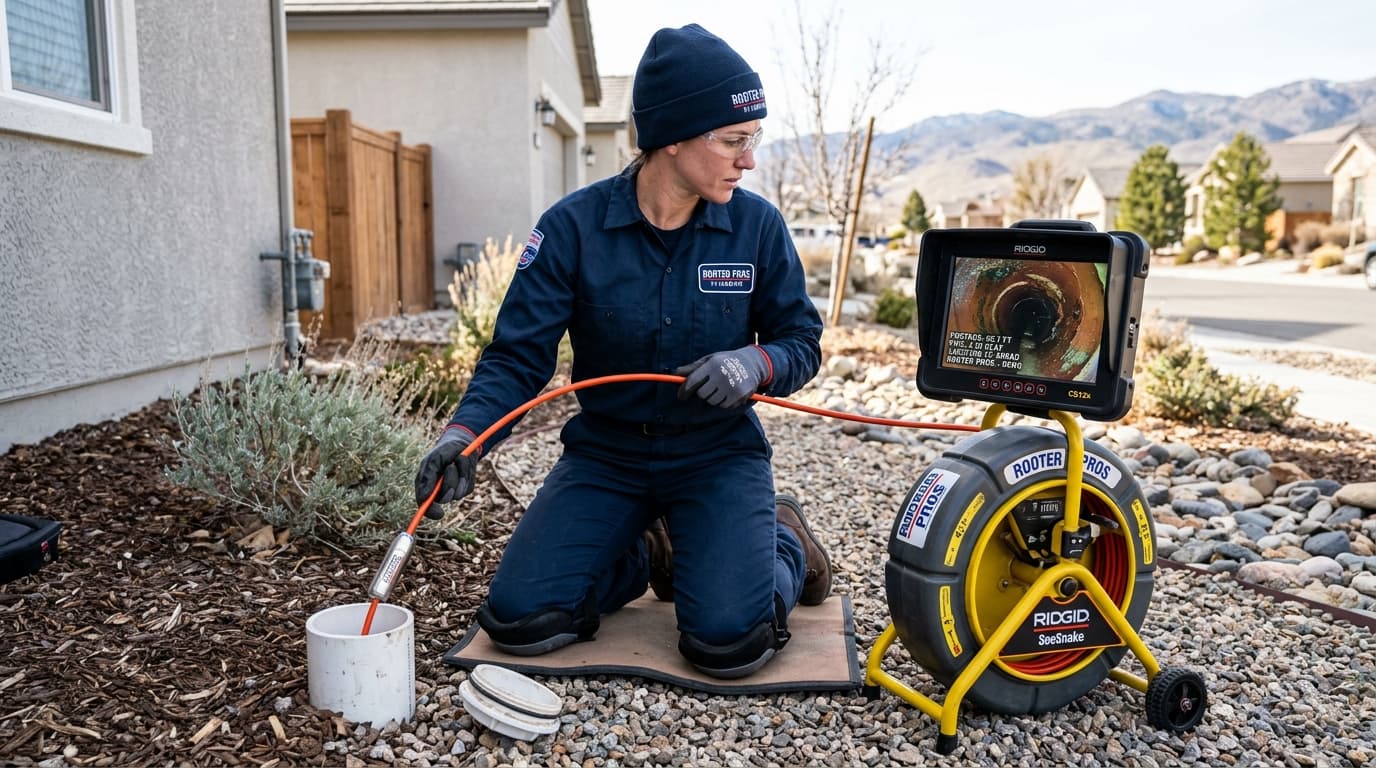
Our approach starts with seeing, not digging. A sewer camera travels the full length of the lateral with a sonde transmitter that logs the exact depth and distance of every defect — you watch the footage with us. Hydrostatic testing confirms whether the line holds water; smoke testing pinpoints where air escapes. Only after the line is documented do we quote repair options at a flat rate, from least disruptive to most — including spot repairs, section replacement, and trenchless methods where the pipe's condition allows them. And the locating data draws the dig plan before a shovel touches soil.
Sewer Line Warning Signs
Sewer lines announce themselves sideways. Any one of these signs justifies a camera inspection — two or more make it urgent.
Toilets and drains that gurgle when other fixtures run are the sound of air fighting water through a partially blocked or bellied line.
One greener, faster-growing line across the lawn is being fertilized from below — the classic surface signature of an exfiltrating sewer lateral.
Soil over a leaking lateral stays damp, then subsides as fines wash away. A dip forming over the pipe's path is a finding, not a coincidence.
Smells that come and go with wind, weather, or water use point to a venting problem or a break letting sewer gas escape the system.
One slow drain is a local clog. Every drain slowing together — and coming back after snaking — is a mainline problem a camera needs to see.
Rodents and drain flies exploit sewer access points. New activity with no food source to explain it can trace back to a compromised lateral.
Noticed a change? Start with a clear description.
Request a Camera InspectionAll Specialties
Sewer Line Leak Detection & Repair is one of nine specialties our Reno crew runs every week — same team, same flat-rate quotes, one 24/7 line for all of them.
Warm floors, damp carpet, or water running under the concrete? We pinpoint slab leaks within inches — no torn-up floors, no guesswork.
View this serviceFrom the meter to your faucets — we trace pressure drops, soggy yards, and humming pipes to the exact break in your main water line.
View this serviceBuried service lines are invisible until the yard turns soft. Acoustic and pressure testing locates the leak so excavation stays small and surgical.
View this serviceIn-wall and ceiling leaks found with thermal imaging and moisture mapping — minimal demolition, maximum accuracy, mold stopped before it starts.
View this serviceBurst pipes and active leaks can't wait — 24/7 emergency response across Reno and Sparks with water shut-off guidance over the phone while we're on the way.
View this serviceCamera inspections, smoke testing, and hydrostatic testing that reveal exactly what's wrong under your yard — roots, bellies, cracks — and the least disruptive fix.
You're viewing this serviceHidden sprinkler and irrigation line leaks waste thousands of gallons every season — zone-by-zone testing finds them and cuts your water bill down to size.
View this serviceHotels, restaurants, offices, and multi-family properties — fast, documented leak location that keeps tenants happy and doors open.
View this serviceSuspect a gas leak? If you smell gas right now, leave and call 911 — then let us find and fix the leak with combustible gas detection and pressure testing.
View this serviceHow It Works
See it, prove it, then price it — in that order, with you watching the footage as we find it.
A short call narrows the story — how long, which fixtures, prior snaking — then we establish access through the cleanout, or a pulled toilet when no cleanout exists.
The camera travels the full lateral. Every root, belly, crack, and offset is logged on video with its exact depth and distance from the access point.
Where the footage is ambiguous, hydrostatic testing shows whether the line holds water, and smoke testing shows exactly where gas escapes the system.
You see everything we see. Repair options are presented least-disruptive first, at flat rates — including trenchless where the pipe's condition allows.
Transparent Pricing
Flat rates, confirmed before we begin — and the inspection ends with you holding the footage, the defect log, and the repair menu, whatever you decide.
| Service | Typical Reno Price | What's Included |
|---|---|---|
| Camera inspection + sonde locating | $195–$395 flat-rate | Full-run video, defect log with depth & distance, marked surface location, written findings |
| Hydrostatic & smoke testing | Quoted with the visit | Confirms whether the line holds water and exactly where it leaks or vents |
| Spot repair at the defect | Flat-rate, quoted on-site | One opening at the marked station — root removal, joint repair, or section fix |
| Section or full replacement | Quoted after footage review | Open-cut or trenchless as condition allows; code cleanout installation included |
Responsibility note: the lateral from your home to the city main is typically the property owner's responsibility; the main under the street belongs to the utility. Sonde locating documents exactly where your problem sits relative to that boundary — before you commit to any repair. Footage and findings also support insurance and utility discussions.
Get a Firm Quote — Call NowYour Repair Choices
The camera decides the repair, not the other way around. You will see every viable option with flat-rate pricing and our honest read on which one your pipe needs.
Roots cut, the joint they entered repaired at one opening. The right call when the rest of the line is sound — the camera tells us that first.
Bellied, collapsed, or shattered segments are replaced at the marked stations — one dig at the defect, not a trench across the yard.
When the line is end-of-life — Orangeburg, fracturing clay — replacing it ends the cycle for decades, and a new code cleanout makes every future inspection simple.
The Equipment
Four technologies, one goal: know exactly what is under the yard before anyone opens it.
Travels the full lateral recording every defect, while the sonde transmitter reports each one's exact depth and distance — located from the surface above.
Isolates the system and holds it under a static water column — if the level drops, the line is losing water, and the footage says where.
Non-toxic smoke under low pressure finds breaks, bad fittings, and illegal connections anywhere in the drain system — visible from the surface above.
Every finding is logged at its station and depth, so the repair plan — and the dig, if one is needed — is drawn on paper before it is drawn in soil.
Understanding Local Leaks
The Truckee Meadows has its own way of working on buried laterals. Four local forces account for most of the failures our camera finds.
Maples, cottonwoods, and elms planted decades ago send roots straight to the wettest joint in the yard — a sewer lateral is the best-watered line on the block.
1960s–80s subdivisions ran jointed clay — roots find every joint — and some-era Orangeburg, which flattens and fractures as it reaches end of life.
Sierra winters flex rigid sewer segments at every joint, season after season. Offsets and step-downs that catch paper and roots start here.
Wet springs and baked summers move Truckee Meadows soil — segments settle at different rates, creating the bellies that pool water and collect debris.
Where We Work
The whole Truckee Meadows, covered from our 89503 base with 60–90 minute typical emergency dispatch. Tap your neighborhood for its local guide.
Common Questions
Leak Detection Reno provides sewer line leak detection & repair and eight related specialties to homeowners, property managers, and commercial properties across Reno, Sparks, and Washoe County — headquartered at 698 N Arlington Ave, Reno, NV 89503. Call (755) 227-9923 or email leakdetectionreno@gmail.com — a person answers 24/7 and flat-rate pricing is quoted before any work begins.